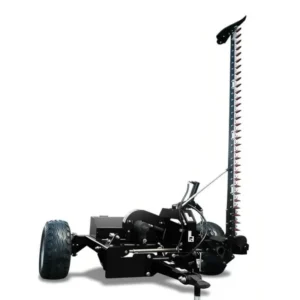
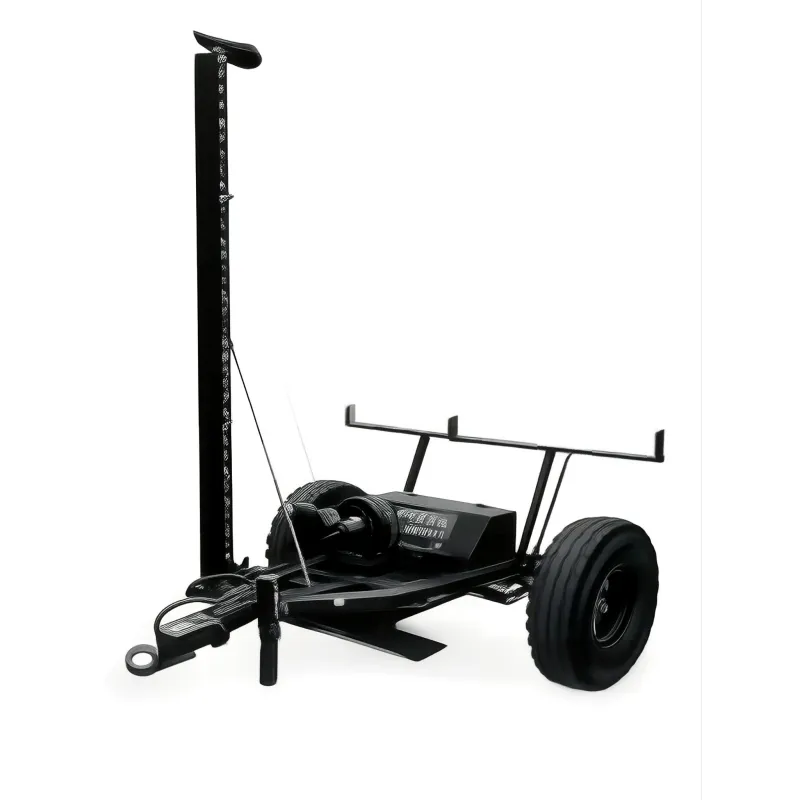
Tondeuse à gazon tractée à lame unique EP-9GD-2.5
The 9GD-2.5 Towed Single-Blade Lawn Mower utilizes a high-precision reciprocating cutter bar system driven by the tractor’s power take-off (PTO), this machine excels in harvesting both natural and planted grasses. As a premier Towed Single-Blade Lawn Mower manufacturer, we have engineered this unit to balance structural durability with operational agility.
Unlike standard rotary mowers, the reciprocating action of the 9GD-2.5 ensures a clean cut at the stem base, which promotes faster regrowth of forage crops like alfalfa, rye, and sudangrass. This model is particularly effective for South Korean agricultural cooperatives in regions like Gangwon-do and Jeju-do, where maximizing seasonal harvest windows is critical for livestock self-sufficiency. By integrating a crank-connecting rod mechanism, the 9GD-2.5 achieves a 2.5-meter working width while maintaining a low power requirement of only 25-40 HP, making it an ideal entry point for farms seeking a high-performance Towed Single-Blade Lawn Mower for sale without the need for heavy industrial tractors.
1. 9GD-2.5 Technical Specifications
| Non. | Article | Unité | Spécification |
|---|---|---|---|
| 1 | Nom du modèle | / | 9GD-2.5 Trailed Single-Blade Mower |
| 2 | Type d'attelage | / | Traîné |
| 3 | Type de structure de coupe | / | Réciproque |
| 4 | Largeur de coupe | m | 2.5 |
| 5 | Matching Power Range | kW | 15-35 |
| 6 | Plage de vitesses de travail | km/h | 6~10 |
| 7 | Nombre de lames mobiles | pièces | 34 |
| 8 | Dimensions (L × l × H) | mm | 2000×4300×950 |
| 9 | Puissance de sortie Vitesse de l'arbre | r/min | 540 |
| 10 | Hauteur de coupe moyenne | mm | 50-70 |
| 11 | Productivité | hm2/h | 2.0-3.0 |
| 12 | Nombre d'opérateurs | (personnes) | 1 |
| 13 | Poids de la structure | kg | 490 |
2. Engineering Excellence: Principles and Scenarios
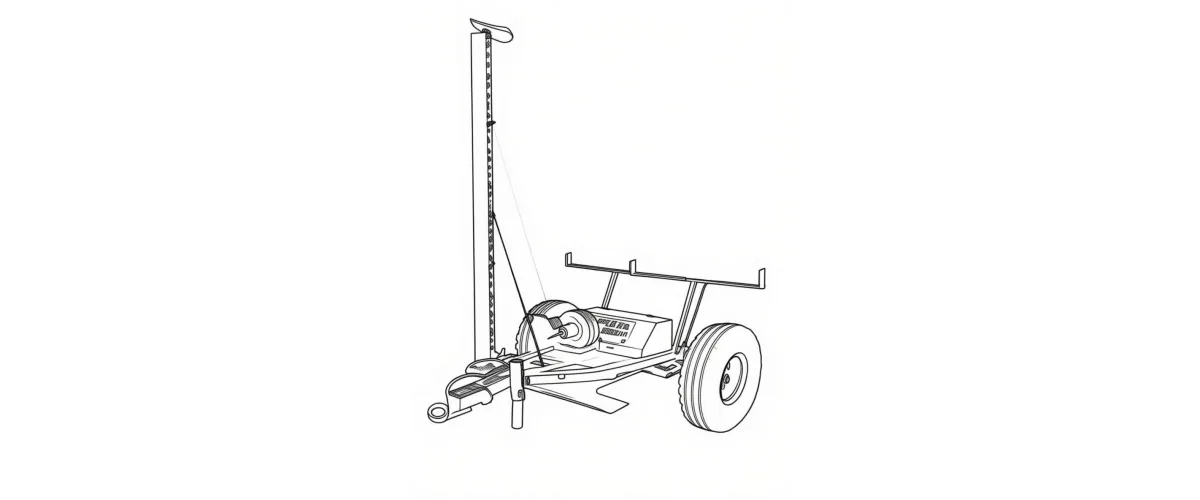
The working principle of the 9GD-2.5 relies on the mechanical conversion of rotational energy into high-speed linear reciprocating motion. The tractor’s PTO shaft transmits power to a primary drive pulley, which then activates the offset crank mechanism. This drives the cutter bar’s knives across stationary guards, creating a shearing effect similar to industrial scissors. This method is preferred in pasture management equipment in Korea because it minimizes soil disturbance and prevents the "shattering" of delicate forage leaves, preserving the nutritional content of the hay.
In terms of materials, the main frame is constructed from high-grade structural carbon steel, while the cutter bar features heat-treated manganese steel blades for exceptional wear resistance and impact durability against hidden field debris. This machine is optimized for various scenarios, including the management of natural mountain pastures, the harvesting of high-density planted forage, and even large-scale landscape maintenance in construction-reclaimed lands. Its towed configuration offers superior tracking and stability on uneven terrains compared to side-mounted alternatives, ensuring consistent cutting height across the entire 2.5-meter swath.
3. Universal Compatibility Matrix
| Marque de tracteurs | Compatibility Status | PTO Requirement |
|---|---|---|
| LS Mtron / TYM / Daedong | High (Standard 3-Point Hitch) | 540 RPM |
| Kubota / Yanmar | High (Category I & II) | 540 / 720 tr/min |
| John Deere / New Holland | Full Integration Ready | Cannelures standard à 6 branches |
4. Regulatory Compliance & Land Management Laws
5. Market Trend Analysis: The Future of Forage Harvesting
6. Usine EVER-POWER : Personnalisation et assurance qualité
Située dans la zone de développement économique et technologique de Hulunbuir, notre usine de fabrication s'étend sur plus de 32 000 mètres carrés Notre usine est équipée de machines de découpe laser CNC de pointe, de lignes de soudage automatisées et de lignes de revêtement en poudre électrostatique. Nous ne sommes pas un simple assembleur ; nous sommes un fabricant complet doté d’importantes capacités de recherche et développement.
Services de personnalisation (OEM/ODM) : Nous savons que les conditions agricoles varient selon les régions. Pour le marché sud-coréen, nous proposons des options de personnalisation, notamment :
• Adaptation hydraulique : Réglage des pressions des soupapes pour correspondre aux débits hydrauliques spécifiques des tracteurs LS ou Daedong.
• Améliorations des pneus : Pneus de flottaison plus larges en option pour les rizières à boue profonde.
• Couleur et image de marque : Services de branding OEM pour les concessionnaires et les distributeurs.
Nous tenons Certification du système de gestion de la qualité ISO9001 et ont été reconnues comme entreprise nationale de haute technologie. Chaque presse à balles 9YG-2.24D subit un test rigoureux de fonctionnement continu de 48 heures avant expédition afin de garantir l'absence de défauts à la livraison.
7. Produits associés
7.1 Boîte de vitesses :
Modèles compatibles : EP-FK263 (presse à balles carrées), série EP-RC30 (presse à balles rondes, rapport de transmission 1:2, compatible avec arbre cannelé 6 cannelures de 35 mm).Application : Transmet la puissance de la prise de force au mécanisme de pressage, convient aux New Holland 630 ou John Deere 535. Paramètres : Couple > 500 Nm, économie de carburant 20%.Pourquoi choisir cette boîte de vitesses : dimensions personnalisables (réductibles à 250-300 mm), résistance aux contaminants visqueux (émanations de caoutchouc), protection IP65. Arbre de prise de force :Modèles compatibles : série EP-PTO (cannelure Z6 1-3/8", longueur réglable 600-1200 mm).Application : Raccordement du tracteur à la transmission principale de la presse à balles, compatible avec le modèle 9YG-1.0C. Rendement de transmission du couple > 95%, compatible avec les brides SAE/EURO.Pourquoi il convient : Conception étanche, adapté aux opérations d’ensilage humide ; remplaçable par la série Weasler.
7.2 Chaînes et pignons :
Modèles compatibles : ANSI chaînes, avec pignon EP (pas 12,7-19,05 mm, diamètre du rouleau 10-12 mm).Application : Utilisé dans les convoyeurs à bande ou les mécanismes de liage, convient au transport de paille en balles carrées/rondes. Largeur : 25 à 40 mm, matériau : acier résistant à l’usure.Pourquoi il convient : Compatible avec les équipements Kobelco ou HF Group, réduit le risque de rupture de chaîne ; une option de qualité alimentaire est disponible pour l’ensilage.
7.3 Accouplements :
Modèles compatibles : Accouplement EP série 200 (couple adapté 500-1000 Nm).Application : Relie la boîte de vitesses au rouleau de la presse à balles, amortit les vibrations.Pourquoi il convient : Durabilité à grande échelle, compatible avec Bondioli et Pavesi.
7.4 Cylindre hydraulique:
Vérin hydraulique : Série EP-HC (alésage 50-100 mm, course 300-600 mm), adaptée au levage de balles.Roulements et joints : roulements 6208-2RS, durée de vie L10 > 10 000 heures, joint étanche à la poussière.Tableau de compatibilité : Entièrement interchangeable avec Comer 250T (couple correspondant, seulement 35% de moins au prix) ; la bride correspond au modèle de prise de force à 4 boulons nord-américain.* Avertissement : Les autres marques citées ci-dessus sont fournies à titre indicatif uniquement. Nous ne proposons aucun produit ni équipement original portant ces marques.Les paramètres varient selon les conditions de fonctionnement ; veuillez vous référer aux schémas. Il est recommandé de vérifier les dimensions de l’interface avant de procéder à la sélection.

8. Frequently Asked Questions (FAQ)
Q1: How much does the 9GD-2.5 Towed Single-Blade Lawn Mower cost for delivery to Busan port?
A1: The **Reciprocating cutter bar mower price** for the 9GD-2.5 varies based on order volume and customization. Generally, for a single unit, the price is highly competitive for the Korean market. To get an exact quote including shipping and insurance to Busan or Incheon, please click our 'Get a Quote' button to speak with a sales representative.
Q2: Where can I find a reliable Towed Single-Blade Lawn Mower manufacturer that ships directly to South Korea?
A2: Jiujia Machinery is a direct-to-market manufacturer with extensive experience exporting to the South Korean agricultural sector. We handle all international logistics and provide direct factory support for the 9GD series, ensuring you avoid middleman markups while receiving genuine industrial-grade equipment.
Q3: What is the recommended tractor horsepower for operating the 9GD-2.5 lawn mower on sloped pastures?
A3: For the 9GD-2.5 model, the optimal power requirement is between 25 and 40 HP (18.4-30 kW)[cite: 1]. If you are operating in sloped regions like the Gangwon highlands, we recommend using a tractor at the higher end of that range (35-40 HP) to ensure consistent PTO speed and towing stability.
Q4: Which reciprocating blade material is best for high-moisture sudangrass harvesting in Korea?
A4: We utilize heat-treated manganese steel for all 9GD-2.5 cutter bars. This material is specifically chosen for its ability to maintain a sharp edge even when cutting high-moisture forage, preventing the "clogging" that often occurs with standard carbon steel blades in humid Korean summers.
Q5: How do I choose between the 9GD-2.5 and the upgraded version for my farm's specific needs?
A5: The standard 9GD-2.5 is designed for maximum cost-efficiency and reliability using a traditional crank-rod system. [cite_start]If your priority is a proven, high-productivity workhorse (up to 2.0 hm²/h) [cite: 1] with simpler maintenance requirements, the standard 9GD-2.5 is the ideal choice for most commercial forage farms.
Q6: What are the maintenance requirements for the crank mechanism in the 9GD-2.5 lawn mower?
A6: To ensure longevity, the primary maintenance task is daily lubrication of the crank pin and connecting rod bearings. We also recommend checking the tension of the drive belt every 20 operational hours. [cite_start]These simple steps prevent mechanical wear and ensure your machine maintains its 5-8 km/h working speed[cite: 1].
Q7: Does Jiujia offer product customization for different tractor hitch standards used in Korea?
A7: Yes! While the 9GD-2.5 comes with a standard towed hitch, we can customize the connection points to match specific LS Mtron or Daedong tractor standards. We can also adjust the PTO spline configuration to ensure a seamless "plug-and-play" experience for your existing fleet.
Q8: When is the best time to replace the cutter bar guards on the 9GD-2.5?
A8: Guards should be inspected every season. If you notice a "tearing" rather than a "cutting" of the grass, or if the stationary edges have become rounded, it is time for a replacement. [cite_start]Maintaining sharp guards ensures you stay within the 30-80 mm cutting height range effectively[cite: 1].
Q9: What safety certifications does the 9GD-2.5 hold for international agricultural equipment markets?
A9: Our equipment is manufactured under ISO 9001 quality management systems and meets the essential safety requirements for international agricultural trade. We provide full technical documentation to assist with South Korean MAFRA safety audits and insurance requirements.
Q10: Why should I choose a towed single-blade mower over a standard rotary mower for livestock feed?
A10: Towed single-blade mowers use a reciprocating cut that preserves the stem's vascular structure. This results in significantly higher forage quality and faster field drying times compared to rotary mowers, which can "beat" the grass and cause sap loss, especially in high-sugar crops like alfalfa.
Éditeur : PXY
*Avertissement : Les autres marques citées ci-dessus sont fournies à titre indicatif uniquement. Nous ne commercialisons aucun produit ni équipement original portant ces marques.